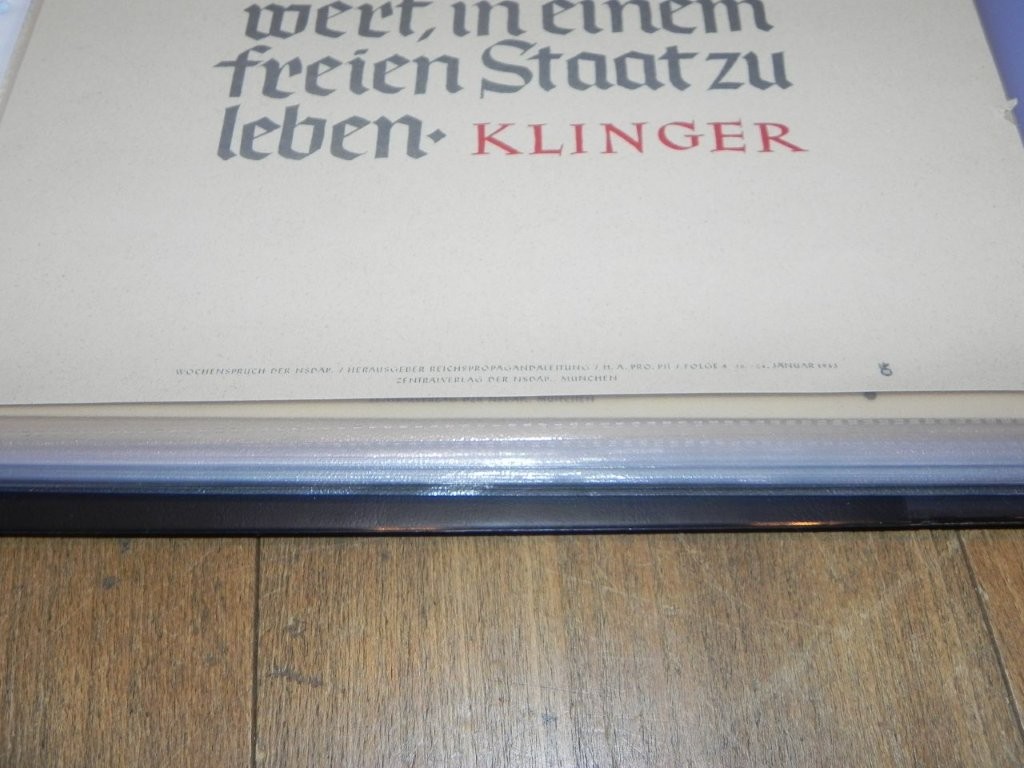
“Wer, wenn das Vaterland in Not ist, einen anderen Gedanken als dessen Rettung fühlt, ist nicht wert, in einem freien Staat zu leben.” (“He who, when the fatherland is in need, feels any thought other than its salvation, is not worthy of living in a free state.” – Friedrich Maximilian Klinger). Weekly quote of the NSDAP – Subscribed to by party members and displayed weekly. This series contains many quotes, also by famous poets and thinkers. Original period sheet “Wochenspruch der NSDAP”, issue 4 (January 18–24, 1943). Published by Reichspropagandaleitung, Zentralverlag der NSDAP, Munich. Size: approx. 24 x 35 cm (must be folded once for standard shipping; shipping unfolded will cost slightly more). Good, age-appropriate condition with minor storage wear. SOLD STRICTLY AS A HISTORICAL COLLECTOR’S ITEM FOR HISTORICAL RESEARCH AND EDUCATIONAL PURPOSES ONLY, NOT FOR PROPAGANDA.
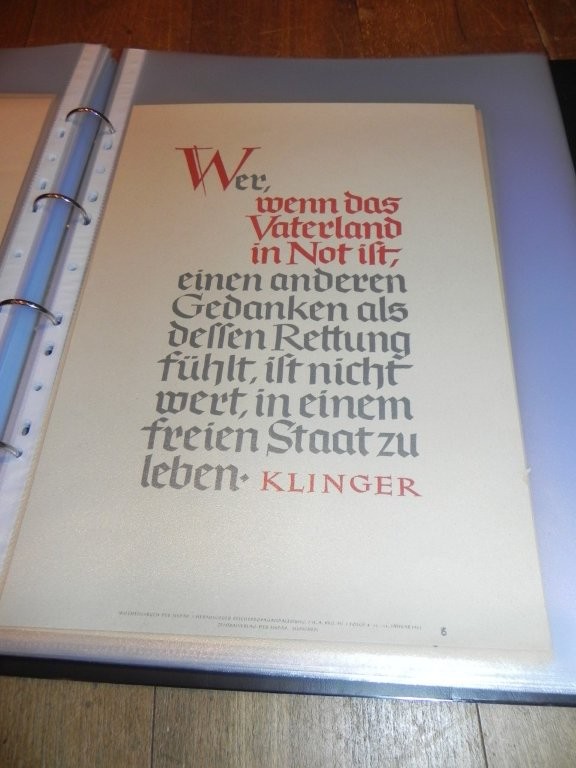
WOCHENSPRUCH DER NSDAP – FOLGE 4 (1943) – FRIEDRICH MAXIMILIAN KLINGER
19,00 €
Product no. 17-929
1 in stock
1 in stock
Smooth reversal
The Wochenspruch der NSDAP was a weekly quotation sheet produced by the Reichspropagandaleitung of the Nazi Party and printed by its central publishing house, the Zentralverlag der NSDAP in Munich. The series first appeared in 1937 and ran into 1944. Each sheet carried one short text for a given week. The text could be a political statement, a wartime slogan or a quotation from an earlier writer, soldier or ruler. The sheets were meant to be displayed in party offices, public buildings, workplaces and similar places, and they formed part of the regime's routine visual propaganda. Central-issue sheets from the war years are typically about 35 x 24 cm. They were often made with calligraphic lettering and sometimes with decorative colour, and designers such as Hoyer were involved. They should not be confused with the much larger Parole der Woche wall newspaper, which was a separate publication from the same office. Collectors identify a sheet by the small imprint line at the foot. It names the publisher, gives the issue (Folge) number and states the calendar week. Some weeks were combined into double issues. Regional Gau editions also existed, especially in the late 1930s.
Description generated with AI
More from this category
More from this category
-
22,00 €
-
19,00 €
-
15,00 €
-
19,00 €