Customers and visitors of www.raskantik.com are only admitted under the condition that they offer, admit or purchase the offered historical and military items, especially those from the NS period, only for: educational purposes, protection against illegal and subversive aims, for scientific and art historical research, the education and reporting regarding historical events, or military history and uniform research.
The company www.raskantik.com Henrik Rask is offering these items only under these conditions.
With the purchase respectively the bidding for items which carry the Third Reich emblem or carry emblems of other important organisations of that time, the bidder commits to using these items only for historical scientific reasons as mentioned above and will by no means use them for propaganda purposes. Such a use would be liable to prosecution according to § 86a StGB (German criminal law) and all potential vendors, vendors and purchasers of such items confirm that they have no intentions whatsoever to commit a punishable offence according to § 86a StGB. Admittance / entries of items will only be accepted under these conditions.
Customers and visitors fully accept these conditions with the acceptance of the online offer.
Nutzungsbedingungen
Vorausgeschickt wird, dass Kunden und Besucher der Homepage www.raskantik.com Fa. Raskantik nur unter der Voraussetzung zugelassen werden, wenn sie die angebotenen zeitgeschichtlichen und militärhistorischen Gegenstände, insbesondere diejenigen aus der nationalsozialistischen Zeit, nur zu Zwecken der staatsbürgerlichen Aufklärung, der Abwehr verfassungswidriger und verfassungsfeindlicher Bestrebungen, der wissenschaftlichen und kunsthistorischen Forschung, der Aufklärung oder der Berichterstattung über die Vorgänge des Zeitgeschehens oder der militärhistorischen und uniformkundlichen Forschung erwerben.
Die Firma Raskantik bietet diese Gegenstände nur unter diesen Voraussetzungen an.
Mit dem Kauf von Gegenständen, die mit Emblemen des Dritten Reiches oder damals maßgeblicher Organisationen versehen sind, verpflichtet der Käufer sich dazu, diese Dinge nur für historisch-wissenschaftliche Zwecke aus den oben genannten Gründen zu erwerben und sie in keiner Weise propagandistisch zu nutzen. Eine solche Nutzung wäre nach § 86a StGB strafbar, und alle Käufer solcher Gegenstände versichern, dass sie keinerlei strafbaren Absichten im Sinne des § 86a StGB verfolgen. Nur unter dieser Voraussetzung werden Bestellungen akzeptiert.
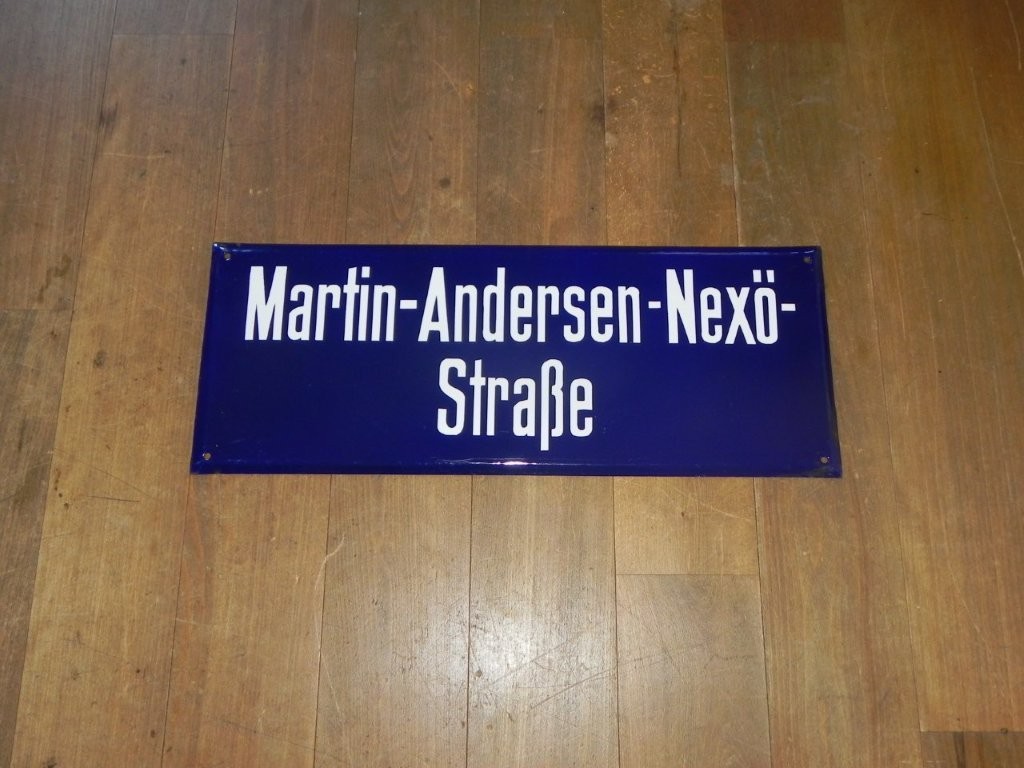
A vintage enamel street sign bearing the name “Martin-Andersen-Nexö-Straße”. Martin Andersen Nexø (1869–1954) was a prominent Danish author, best known for his working-class masterpiece novels “Pelle the Conqueror” (Pelle Erobreren) and “Ditte, Child of Man” (Ditte Menneskebarn). Following his arrest in 1941 due to his communist membership during the occupation of Denmark, he escaped from an internment camp in 1943 and fled to neutral Sweden. He later moved to the Soviet Union and eventually permanently relocated to East Germany in 1951, where he lived as a highly celebrated writer until his death. His literary focus on social realism made his works iconic in East Germany, leading to numerous streets being named in his honor during the post-WWII and DDR era.
Format: Landscape format orientation (Querformat).
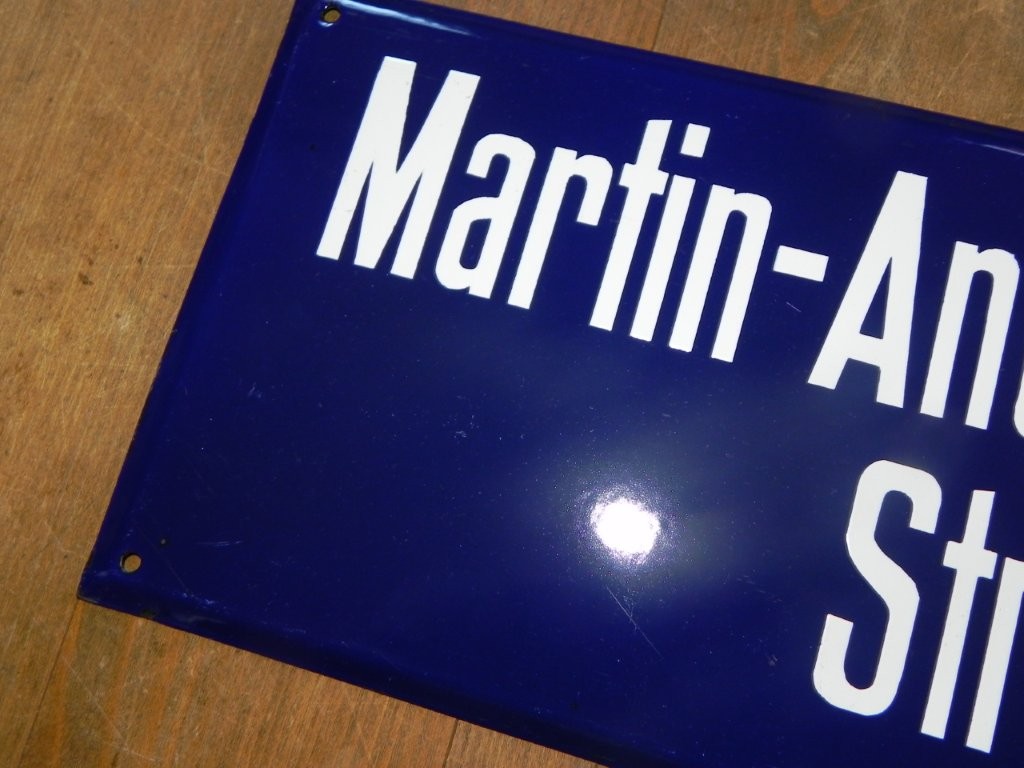
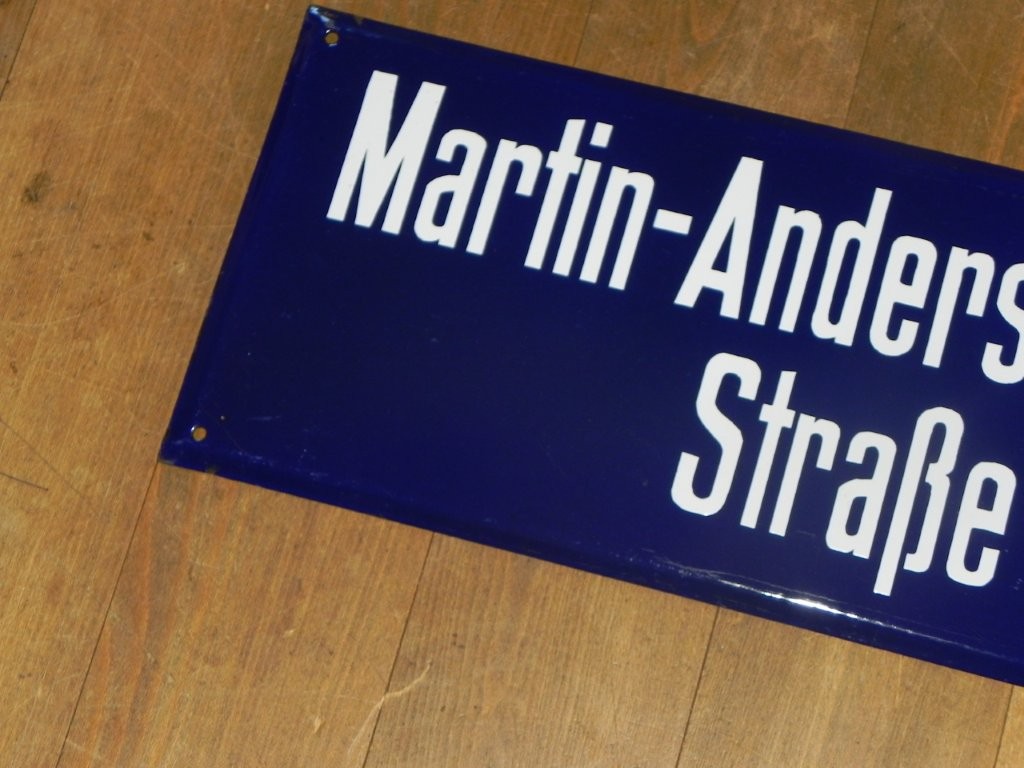
Text: Stenciled white typography over two lines against a cobalt blue enameled background with a thin white border.
Period: DDR / Post-WWII era.
Dimensions: 65 cm x 25 cm.
Mounting: Fabricated with pre-punched corner holes for secure wall mounting.
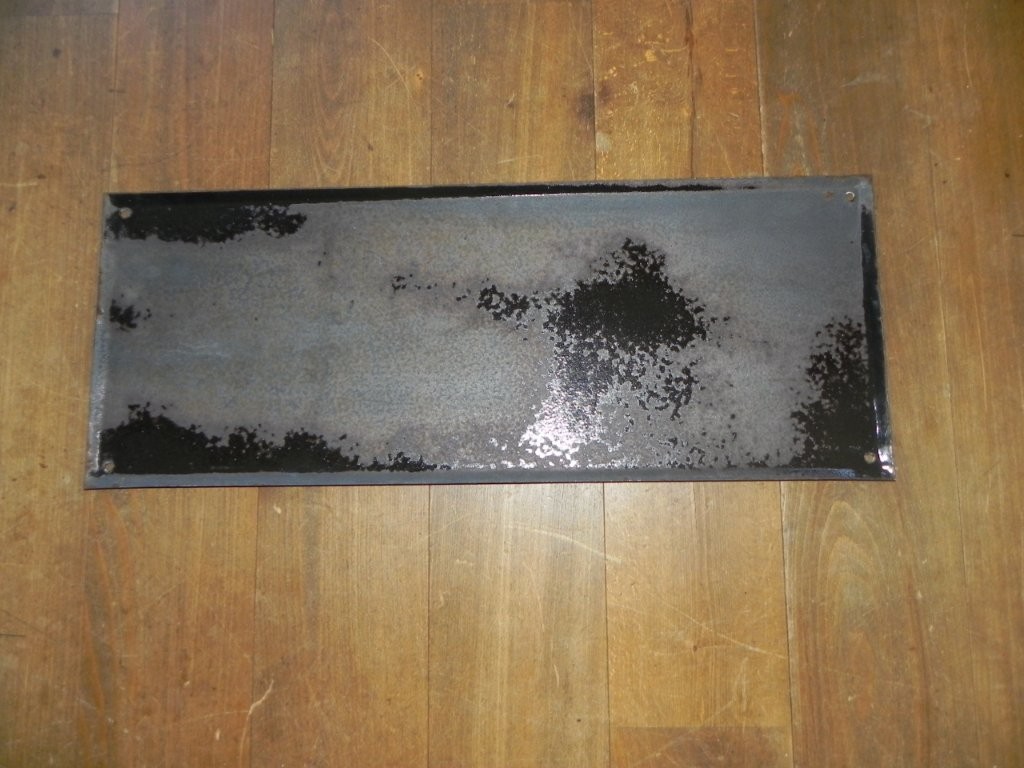
Enamel street signs are vitreous-enamelled sheet-steel nameplates that German municipalities used to mark streets. They were normally fixed to building walls or posts through pre-punched holes in the corners. A steel blank is coated with glass-based enamel and fired at high temperature, which makes a hard, glossy surface that resists weather. Lettering is applied in a contrasting enamel layer and can sit very slightly raised. Signs from the 1930s and 1940s are often gently curved (bow-fronted) and usually have a border. Flatter plates became common later, and enamel signs stayed in use in East Germany. Streets were renamed after 1945, so a name honouring a figure of the socialist state points to the DDR period, not the Third Reich. Martin Andersen Nexø (1869–1954) was a Danish novelist who spent his last years in Dresden. Several East German towns named streets after him, and Dresden's street was named in 1981, so naming dates vary by town. Collectors tell signs apart by lettering style, profile, enamel build-up, maker or size stamps on the reverse, and the historical background of the street name.
To provide the best experiences, we use technologies like cookies to store and/or access device information. Consenting to these technologies will allow us to process data such as browsing behavior or unique IDs on this site. Not consenting or withdrawing consent, may adversely affect certain features and functions.
Functional
Always active
The technical storage or access is strictly necessary for the legitimate purpose of enabling the use of a specific service explicitly requested by the subscriber or user, or for the sole purpose of carrying out the transmission of a communication over an electronic communications network.
Preferences
The technical storage or access is necessary for the legitimate purpose of storing preferences that are not requested by the subscriber or user.
Statistics
The technical storage or access that is used exclusively for statistical purposes.The technical storage or access that is used exclusively for anonymous statistical purposes. Without a subpoena, voluntary compliance on the part of your Internet Service Provider, or additional records from a third party, information stored or retrieved for this purpose alone cannot usually be used to identify you.
Marketing
The technical storage or access is required to create user profiles to send advertising, or to track the user on a website or across several websites for similar marketing purposes.